Go
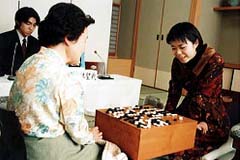 The game of'Go'has its origin in China 4,000 years ago. It is more then 1,300 years
since'Go'was introduced to Japan. During these centuries, the ancient Chinese form of'Go'has
been modified and improved by the Japanese.'Go'as it is played today is an indoor game which
has no further room for improvement. It has taken roots deep in the life of the people of
Japan. The total number of people who play'Go'is estimated to be about seven million.
The game of'Go'has its origin in China 4,000 years ago. It is more then 1,300 years
since'Go'was introduced to Japan. During these centuries, the ancient Chinese form of'Go'has
been modified and improved by the Japanese.'Go'as it is played today is an indoor game which
has no further room for improvement. It has taken roots deep in the life of the people of
Japan. The total number of people who play'Go'is estimated to be about seven million.
There are many'Go'players outside Japan-a fact which should be a source of joy for us. Now,
what kind of game is'Go?'
'Go'is a game in which two players contest for territory. One of the two players uses black
stones and the other white stones to mark out their respective territories. The player who
has captured more territory at the end of the game is the winner. Since the players are to
fight against each other over territory within a limited space, the game involves many varied
forms of contest. This is what makes'Go'so interesting.
If you interested in and want to know more about 'GO'.
Please visit "Nihon
Ki-in Home Page". You will see much about 'GO'.
Nishikigoi
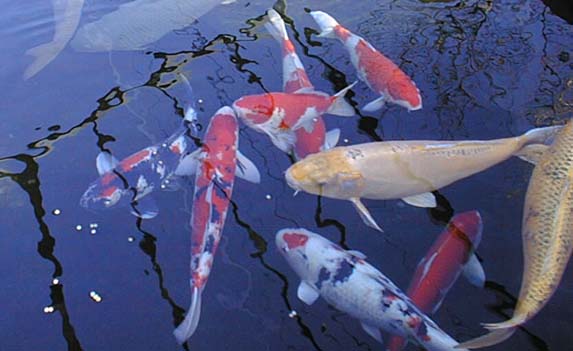
Nishikigoi is a general term for colored carp which are bred for appreciation.
The original home of the carp was said to be Persia. They were brought to Japan through China
and Korea about 1000 years ago. And a colored carp was born among black carp for food by
mutation. After mating it with other carp, the Nishikigoi was bred. A colored carp were
born in Japan. They are a work of Japanese art.
A The Nishikigoi is very colorful and called "Living jewel" or "Fancy carp". The carp is
the largest of all the fresh water fish. They grow rapidly. Their average growth is 55-70
centimeters in ten years. The average span of the carp's life is said seventy uears, but some live
more than two hundred years. Becouse some of them live as long as cranes and turtles, they
are also named "fish of celebration".
The carp is brave and never writhes even when it is cut, so it is called a samurai fish.
And also it is said that the carp can swim upwards against a waterfall. From this the fish
is a symbol of rising in the world. It is served at dinner of celebration. Thus the carp
is regarded a luck bringer. Japanese people like to have gardens around their houses and put Nishikigoi in ponds
in their gardens.
(Refer to "Manual to Nishikigoi" by Takeo Kuroki)
Nishikigois in my pond
Ikebana
My wife and her Ikebana
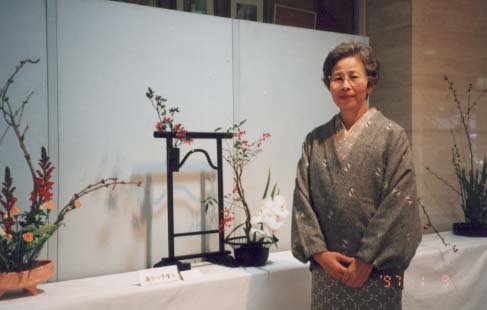
The history of flower arranging, known in Japan as Ikebana or Kado, is clouded, but most
historians agree that this purely Japanese art form came into prominence as visual addendum to
the tea ceremony as practiced at Ginkaku-ji Temple in Kyoto during the 45th century. Over
20 nationally famous styles (schools) of Ikebana apply their own particuler philosophy
of arrangement, but a common concept holds that the arranged flowers should represent ten-chi-jin
(heaven-earth-man). The ten-chi-jin classical arrangement dictates that the main upwerd
branch represents heaven; branches to the right are men; and the lowest branches on the left
are the earth. Attention is also given to the kind of flower used, where it is placed, and
the shape of the vase that hold it. Most arrangements are very simple and not at all like floral
bouquets prevalent in the West. Ikebana can brighten any spot,but a favorite spot to display
them is in the tokonoma(religious alcoves) of home, where they are placed near,but not obscuring,
the kakemono(picture scroll);the artful arrangement blends,but never competes, with this
place of honor.
You can see much more about Ikebana in Ikenobo(One of the famous style) English Home Page
"Ikenobo Ikebana Society"

