Apr. 1,2001
Trip to Cambodia

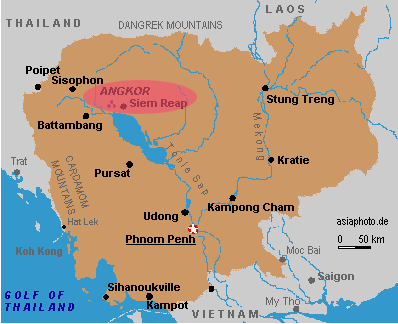
Hi, how are you ? I've visited Ankor Wat in Cambodia for 4 days from March 10th of 2001. Please read my Cambodia Tales for a while.
(Day 1) Nagoya Bangkok Siem Reap (Cambodia)
[Nokor Phnom Hotel]
(Day 2) Ankor Wat, Ankor Thom
[Nokor Phnom Hotel]
(Day 3) Sra Srang, Banteay Kdei, Takeo, Preah Khan, Neak Pean, Ta Som, East Mebon, Prey Rup,Phnon Bakheng
[Nokor Phnom Hotel]
(Day 4) Tonle Sap Lake Siem Reap Bangkok Sightseeing in Bangkok City.
(Day 5) Bangkok Nagoya

We flew for an hour or so, from Bangkok and landed at the small Siem Reap airstrip at 7:00pm to visit Ankor Wat. Siem Reap Airport is quite small. And entry formalities are very simple. We can apply for our Cambodian visas after we entered the arrival area. First of all we have to do is go to the visa counter and hand the filled visa application that we had received on the plane, a small photograph and $20 to an official. Soon we get a visa.
After we get the visa, go to the Immigration counter and get an entry permit. That's all.
Before I leave Japan, I read much about Cambodia on website. Many peoples are writing about dangerous situations in Cambodia.
But everything seems to have changed a little, and Cambodia is now a safe country to travel. Cambodian people I met in Siem Reap was very friendly. There are obviously less kids at a sightseeing places selling water, postcards, flutes and offering guide services. If you say no they normally leave you alone.
I did not feel any danger and always felt perfectly safe during our stay.

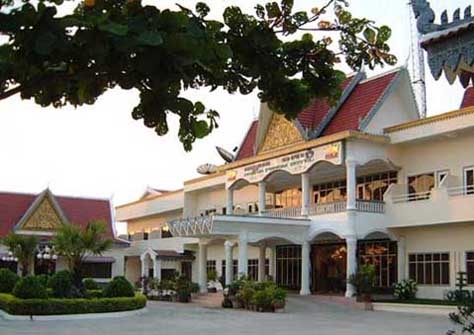
Nokor Phom Hotel

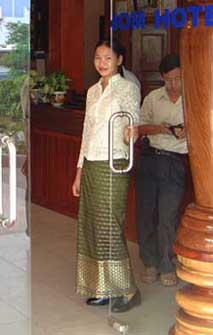
Friendly Door Lady
Nokor Phom Hotel that we staied is very exotic and fantastic on the outside. A lady who wear traditional clothes and welcomed us at the door was fantastic too. I really felt I am in a exotic foreign country now.
Like this our adventure to the Angkor, the center of a big kingdom between the 9th and the 13th century, started.

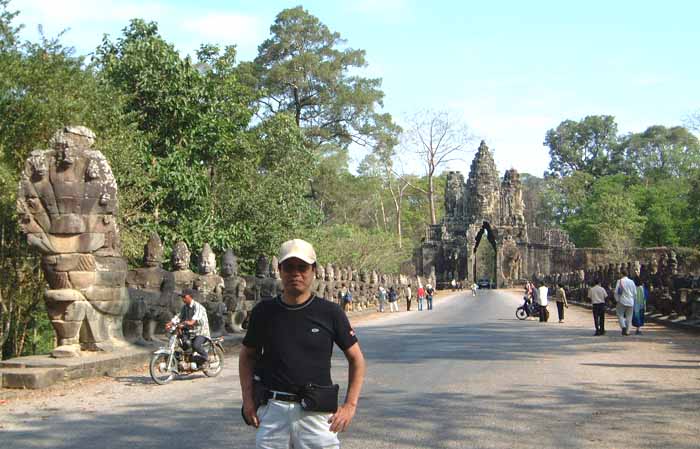
The South Gate of Angkor Thom

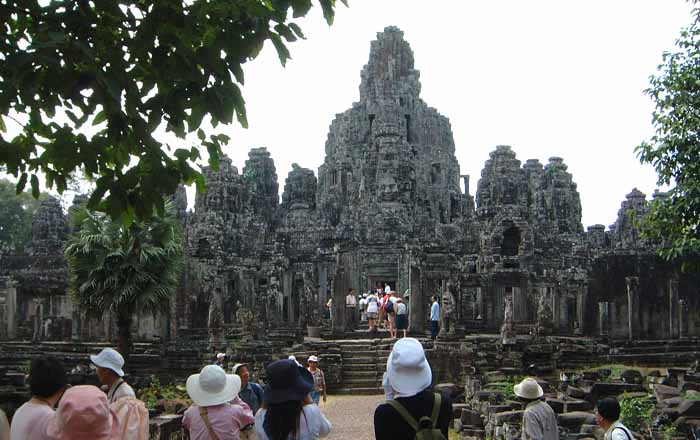
The Bayon Temple

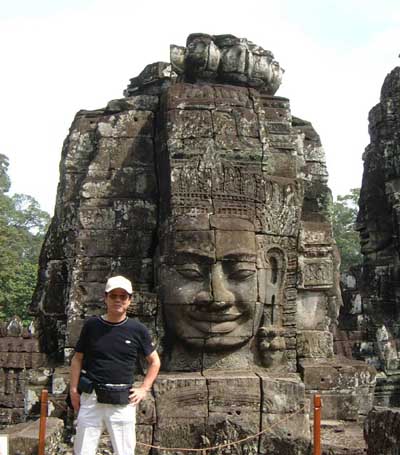
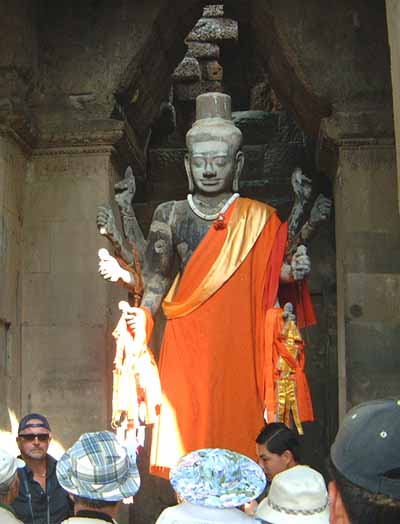
Avelokitesvara of the Bayon Temple
The Bayon Temple is in a walled city called Angkor Thom, some 10 square kilometers large. It was built between 1181 and 1201 AD. A square wall, eight meters high and 12 kilometers long marks its borders. The four gates are each topped with a smiling face of the Avelokitesvara.
The Bayon is famous for its 54 stone towers and over 200 faces of the Avelokitesvara, each visage bearing an enigmatic Buddhist smirk. Everywhere you looked - in every direction, at every possible angle it seemed - was this huge, peaceful grin, its eyes slightly opened as if in a state of meditation.


The Angkor Wat

A Hindu God

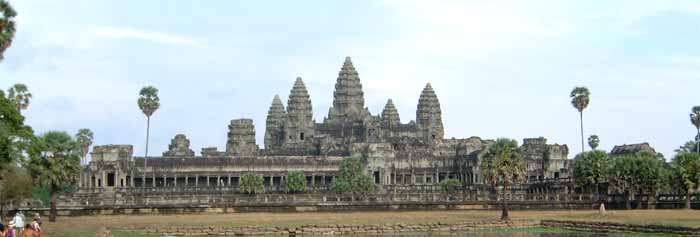
Angkor Wat was constructed under King Suryavarman II (reigned 1113-1150) to celebrate the king as the incarnation of the Hindu god Vishnu. The temple area is more than two square miles big and surrounded by a 500 foot wide moat. Dedicated to Shiva and Jayavarman VII, Angkor Wat served as the king's funerary temple.
As we walk inward along the first causeway and moat through the gate, we reach the second causeway. Here the grand facade of Angkor Wat comes into full view (pictures above). The causeway, that leads to the heart of the temple, is 350 metres in length. The famous Angkor Wat reliefs surround the first level, where Epic events are displayed in graphic detail on a lenghth of almost one kilometer.


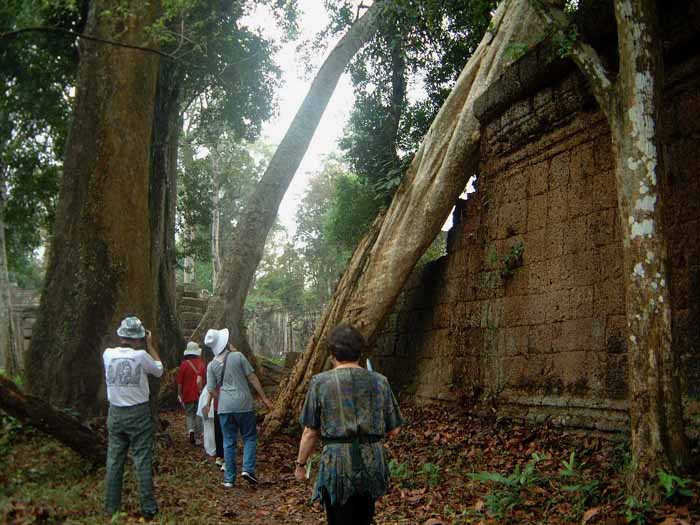
Some temples are turned into a pile of stones by pressure of trees

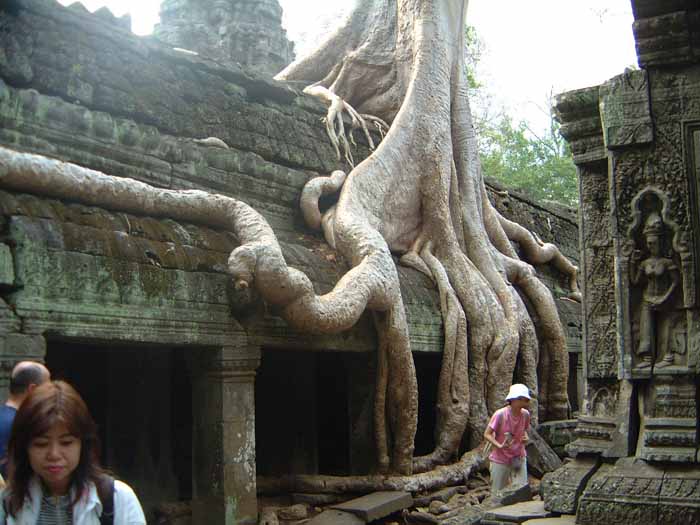
Ta Promh Temple, a vast monastery left in its natural state

Ta Promh, a Buddhist temple left in exactly the same state the French found it in 1860. Big trees have grown over the stones, have cracked them apart but help at the same time to maintain the structure. A strange symbiosis between nature and culture.
The temple was erected in 1186 and had the function of a budhist monastery. Inside of the temple there lived 18 priests, 2700 monks, 600 dancers and 12000 servants.


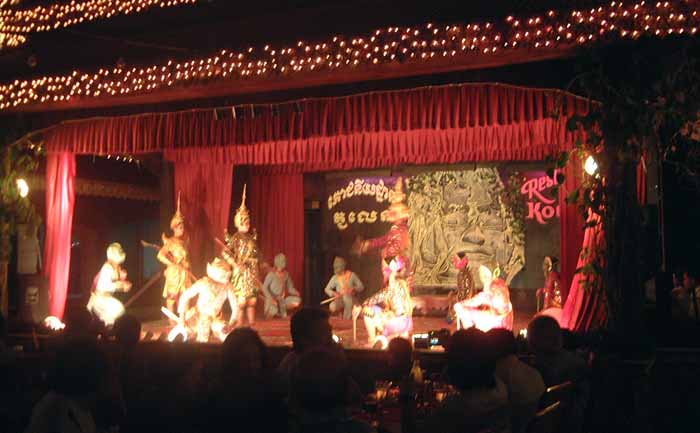
Traditional Cambodian Dance

The last evening of our Angkor trip we went to a restaurant theater to see a traditional Cambodian dances. There was a combination of classical dances and folk dances. They invited us into a fantastic world.


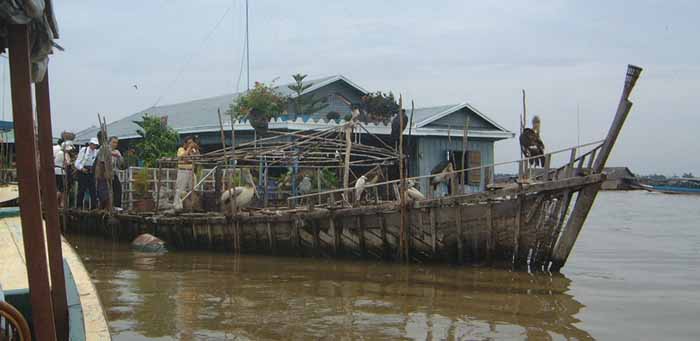
A floating shop on the Tonle Sap Lake

The Tonle Sap Lake is very big. It is eight times as big as Lake Biwa (the biggest lake in Japan). In March the water level of the Tonle Sap Lake is extremely low. During the rainy season the size of the lake is up to seven times bigger than in dry season. Many families are living on houseboats and there are many floating villages.

Days are passed so fast. We boarded a aircraft again for the flight to Bangkok and enjoyed the watching a view of the Angkor from a few thousand meters above.

Well,sayonara and see you again soon.

Back to Top