Oct. 19,1999
We Visited China
5-Days China Tour
(4 - 8 Oct.'99)
(Day 1) Nagoya  Tianjin Tianjin  Beijing Xi'an Beijing Xi'an
[Xi'an Garden Hotel]
(Day 2) Visited the Huaging Hot Springs, the Qin Terra-cotta Warriors, the Mausoleum of Qin Shihuang, The Big Wild Goose Pagoda and the West Gate of Xi'an.
[Xi'an Garden Hotel]
(Day 3) Visited the Forest of Stone Steles Museum and the Shaanxi Provincial History Museum.
Xi'an Beijing
[Jinglun Hotel]
(Day 4) Visited the Ming 13 Tombs and the Badaling Great wall. The Beijing Duck Dinner at the hotel and after the dinner traditional classic entertainments at the theater were served.
[Jinglun Hotel]
(Day 5) Visited the Tian'anmen Square and the Forbidden City (the Imperial Palace Museum).
Beijing
Tianjin Nagoya
|
Hi !! How are you ?
My wife and I visited China (Xi'an and Beijing) at the beginning of this month for the first time. Though It was only 5 days short visit, I could study much about the newest China.
The first day, on our way to Xi'an we passed through Beijing by bus. Driving through Beijing I looked eagerly out of the windows to see what China is like. It's like Nagoya, or any of a dozen major cities I've ever visited. High rise buildings, traffic jams, and not a lot of bicycles that I saw in our TV. People's fashion we see in a street were no difference with us. People looks very friendly and I was beginning to feel very at home.
[ Xi'an ]
We arrived at Xi'an after dark. The main street of Xi'an was brightly lit by the road side lights. And at the end of the street there was illuminated old Bell Tower (Originally from 14th century, this huge tower was relocated in 1739). It was very fantastic scenery.
After an evening meal we arrived the Xi'an Garden Hotel which has a big Chinese courtyard. Four star international standard. The hotel is really nice. I was expecting something rather more primitive, so this is a pleasant surprise. We went to bed at 12:30 in midnight and had a good sleep.
Xi'an is the capital of Shaanxi Province and also the political, economic and cultural center of the Northwest China. With the development of travel industry and the implementation of the open policy, it has become one of the nation's key tourist cities and tourism has become the mainstay in Shaanxi's economy.
The area around Xi'an was inhabited by the progenitors of the Chinese nation as far back as 500,000-600,000 years ago. In the 1960s, archaeologists discovered in Lantian County to the southeast of Xi'an human fossils and cultural relics belonging to the Paleolithic Period. In the 1950s, the remains from the Neolithic Period were discovered at Banpo Village to the east of Xi'an City. In the 70s, the Jiangzhai Ruins from a later part of the Neolithic period were discovered at Lintong County to the northeast of Xi'an City. These archaeological discoveries indicate that the area around Xi'an is one of the cradles of Chinese civilization. We can see the fossils of the "Lantian Man" at the Shaanxi Provincial History Museum. As I am interested in ancient history of human being, when I saw the "Lantian Man" I was deeply impressed.
As one of the six ancient capitals in China, Xi'an served as the seat of 12 imperial capitals for 1,120 years after Chinese society had entered the civilized stage.
Xi'an is also a world-famous tourist city, a treasure house of cultural relics. The remains of past civilizations furnish evidence of every major epoch in China's half a million history, making for a particularly illustrative textbook of Chinese culture. The history apparent in Xi'an is so ancient and continuous that the city has no parallel anywhere as a cultural site. Here one can visit the sites once inhabited by its primitive people; admire the bronze wares manufactured in the Bronze Age; wander through the city ruins of the Qin, Han, Sui and Tang Dynasties; imagine for oneself the clamour of the old Oriental metropolis; explore the imperial tombs of the Qin, Han and Tang Dynasties, testimony to the pervasive power of the feudal ruling class; ramble in temples and pagoda courtyards, tracing vestiges of the Silk Road; and study stone inscriptions to 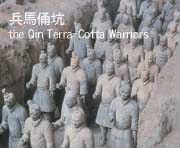 appreciate Chinese calligraphy. Not least, Xi'an is the site of excavation of the vast army of terra-cotta warriors and horses from the tomb of China's First Emperor, Qin Shihuang, from whom the country derives its name.
Xi'an was the starting point of the world-famous Silk Road. It can be well likened to a history museum. Moving around this old city is like going through thousands of years back in time. In this vast museum you will see the Banpo Village Remains of a matriarchal community; the Huaqing 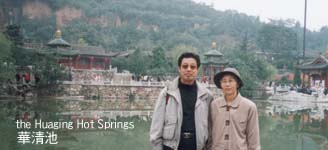 Hot Springs which was noted as early as the Zhou Dynasty more than 3,000 years back; Qin Shihuang's terra-cotta warriors and horses, known as the eighth wonder of the world; the imperial cemetery grounds of the Han and Tang dynasties; the Great Mosque with unique features; the Big Wild Goose Pagoda and the Small Wild Goose Pagoda built in the Tang Dynasty; the Bell Tower and the Drum Tower of the Ming Dynasty; and the Forest of Steles with a rich collection of age-old stone steles.
[ Beijing ]
The third day's evening, we came back to Beijing again. After an evening meal we arrived the Jinglun Hotel which is in the center of Beijing. Four star international standard. This hotel is really nice,too.
Beijing is the capital of the People's Republic of China and it is China's political and cultural center. It covers an area of 16,808 square kilometers and has a population of over 11 million.
Archaeological discovery has shown that Beijing is a cradle of the Chinese nation. It is here that the "Peking Man" -- an ancestor of the ancient Chinese nation -- multiplied about half a million years ago. About 3,000 years ago, Beijing became an important town in North China. In the 11th century B.C., a northern kingdom called Yan established its capital in Beijing, which was then known as "Yanjing". Later, the Kin, Yuan, Ming and Qing Dynasties (1115-1911) all made Beijing their capital, so that it served as China's political center for 700 years. Construction during various feudal dynasties has left Beijing a host of historical and cultural relics, imperial palaces and gardens, imperial residences, temples, pavilions, archways and stone carvings. These, unique in the world, have earned Beijing the name of a historical and cultural treasure house. Since New China was founded in 1949, Beijing has undergone new changes and become a modern city.
The most famous sightseeing place in Beijing is the Great Wall and the Forbidden City.
The Great Wall extends for a good 3,000 miles from its origin at the seaside in Shanhaiguan (the Old 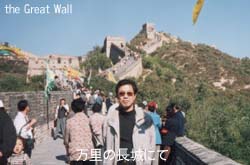 Dragon Head), a seaport along the coast of Bohai Bay in the east, all the way to Jiayu Pass in Gansu Province. Stretching from the eastern part of Liaoning in Northeast China to Lintao (in modern Minxian) on the desert in the northwest of China, it passes through Liaoning, Hebei, Beijing, Shanxi, Inner Mongolia, Shaanxi, Ningxia, and Gansu. The Chinese li equals 0.5 kilometer, so the Great Wall is 10,000 li long in Chinese measurement and hence it is known in Chinese as the Ten-Thousand-Li Long Wall. Serious readers who measure it on the map will find out that the actual distance is only about 3,000 kilometers since the wall zigzags along the mountain ridges!
The Great Wall was a gigantic defensive project used in ancient times as early as in the 7th century B.C. For self-protection, rival kingdoms built walls around their territories, laying foundations for the present Great Wall. When Qin Shihuang (First Emperor of the Qin) unified the whole country in 221 B.C., the existing walls were linked up and new ones added to counter attacks by the remnants of the defeated states. The undertaking of such a huge project over difficult terrain at that time without any machinery was an extraordinary feat. A workforce of nearly a million, representing one fifth of the whole labor force of the country, was used to build it. Hardship and cruel treatment brought death to many of the laborers, and tragic stories were told, from which folk-tales and legends came into being.
The Forbidden City (the Imperial Palace Museum) was the place where the emperors of the Ming and Qing Dynasties carried out their administration and lived. Now it is open to the public as a palace museum where people can see the great traditional palace architecture, enjoy the treasures kept in the palace, and learn of the legends and anecdotes about the imperial family and the court.
 Construction of the Forbidden City started in the 4th year of the reign of the third Emperor of the Ming Dynasty, Emperor Yongle, and was completed 14 years later (1420). It involved approximately 1,000,000 workers, including 100,000 artisans. The timber needed for the construction was brought mostly from southwest provinces such as Sichuan, Hunan and Guizhou, while most of the stones were quarried from the district of Fangshan -- a suburban area of Beijing.
Altogether 24 emperors lived here over a span of 491 years in two dynasties, ending with the last emperor in 1925. A film about Puyi, The Last Emperor, is well-known in the West. It is quite an experience to see halls and courtyards where those scenes were played out, both on film and in real life.
Construction of the Forbidden City started in the 4th year of the reign of the third Emperor of the Ming Dynasty, Emperor Yongle, and was completed 14 years later (1420). It involved approximately 1,000,000 workers, including 100,000 artisans. The timber needed for the construction was brought mostly from southwest provinces such as Sichuan, Hunan and Guizhou, while most of the stones were quarried from the district of Fangshan -- a suburban area of Beijing.
Altogether 24 emperors lived here over a span of 491 years in two dynasties, ending with the last emperor in 1925. A film about Puyi, The Last Emperor, is well-known in the West. It is quite an experience to see halls and courtyards where those scenes were played out, both on film and in real life.
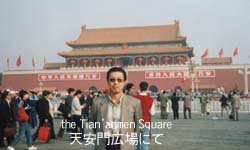
The Tian'anmen is the first gate to the Forbidden City(the Imperial Palace). In front of this gate there is the famous Tian'anmen Square which is the largest square in the world today.
At the evening of October 8th, we came back to Nagoya. It was very nice trip.
Well, Sayonara, and see you again soon.
