Aug.15,2001
Trip to Viet Nam
Hi, how are you?
At the beginning of July I've visited Ho Chi Minh City in Vietnam, formerly known as Saigon. (Saigon was renemed after Ho Chi Minh on 2 July, 1976.)
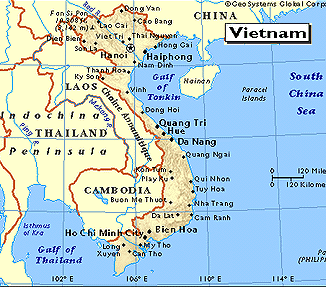 Vietnam borders Cambodia, Laos and China and stretches over 1600km along the eastern coast of the Indochinese Peninsula. The country's two main cultivated areas are the Red River Delta (15,000sq km) in the north and the Mekong Delta (60,000 sq km) in the south. Ho Chi Minh City is in the Mekong Delta, and it is very pleasant looking city, as it was called "Petit Paris" before the war.
Recently, a trip to Viet Nam is very popular among a Japanese young ladies. During my stay in Ho Chi Minh I understood the reason.
In this, the largest of Vietnam's city, I saw the hustle and bustle of Vietnamese life everywhere, and there is something invigorating about it all. Contrasting image of the exotic and mundane abound. There are the street markets where bargains are struck and deals are done, the pavement cafe where stereo speakers fill the surrounding streets with a melodious thumping beat, and the sleek new cafes and pubs where tourist chat over beer, pretzels, coffee and croissants. Thousands of motorbike in the wide boulevards of pleasant looking city. A young office lady maneuvers her HONDA through rush-hour traffic, long hair flowing, high heels working the brake pedal. The people, dressed in a wide variety of clothing from lovely Ao Dais to Western suits, appeared lively and attractive.
(Day 1) Nagoya  Seoul Ho Chi Minh (Viet Nam) Seoul Ho Chi Minh (Viet Nam)
[Garden Plaza Hotel]
(Day 2) �@ �@Reunification Palace,War Remnants Museum,Ben Thanh Market,History Museum,Cholon District, Thien Hau Pagoda,The Saint-Maric Cathedral �@Reunification Palace,War Remnants Museum,Ben Thanh Market,History Museum,Cholon District, Thien Hau Pagoda,The Saint-Maric Cathedral
[Garden Plaza Hotel]
(Day 3) Mytho  Mekong Boat Tour,Con Thoi Son Mytho Van Thanh Mieu Temple,Dong Tam Snake Farm,Hang Bong Market Ho Chi Minh Mekong Boat Tour,Con Thoi Son Mytho Van Thanh Mieu Temple,Dong Tam Snake Farm,Hang Bong Market Ho Chi Minh
[Garden Plaza Hotel]
(Day 4) Cu Chi Cu chi Tunnels Ho Chi Minh
(Day 5) Seoul Nagoya
|
[ Motorbike City ]
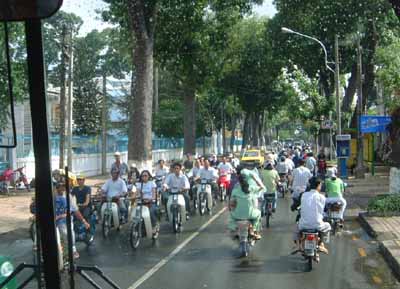
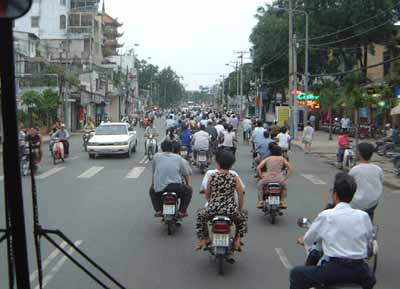
On arriving in Ho Chi Minh, my first surprise was the wide boulevards filled with the incessant rattling of motorbike traffic. Our Vietnamese guide told us that the population of Ho Chi Minh City is 5,300,000 and the number of motorbike in the city is 2,500,000. As half of the populations are child and aged person, the most of adults has a motorbike.
Ho Chi Minh's motorbike culture is characterized by the intense intimacy of its colorful and bustling streets. Most vehicles travel at relatively slow speeds, so accidents are few and tempers rarely flare when people brush or nudge each other. People are constantly treated to an armslength view of their fellow commuters. Conversations, even flirtations, are spontaneous, casual and common. Even in the worst traffic jams, people remain calm, poised and always armed with a smile instead of a sneer when the smoggy, slow and crowded conditions become too much to handle.
Fashionably-dressed women with designer sunglasses, high heels and elbow-length gloves cruise past on their Hondas, peddling bicycles and holding hands. With few traffic light, intersections are negotiated by slowing down and then weaving through the cross traffic, making eye contact with the closest riders. Pedestrians cross the street by simply walking into the melee, hardly breaking stride as the traffic swirls around them. It all sounds crazy, but it works!
|
|
|
Every streets are filled with motorbike.
|
[ Ladies dressed in Ao Dais ]
Before I visit Vietnam, I supposed I can see many young ladies who wear a traditional Vietnamese ao dai. But I could find very few ao dai lady in the streets.
I asked why to our guide.
"Now, it is summer vacation."
He answered. I could not understand the meaning immediately. He continued.
"All girl student wear a white ao dai. You will see a lot of ao dai girls when the school starts."
Now, I understood everything.
Most of the people of this country wear a western style clothes now. And they do not wear a traditional ao dai in their daily life any more.
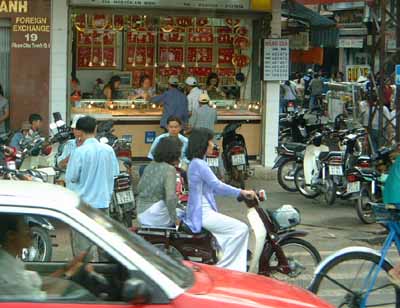
At the Market Place.
|
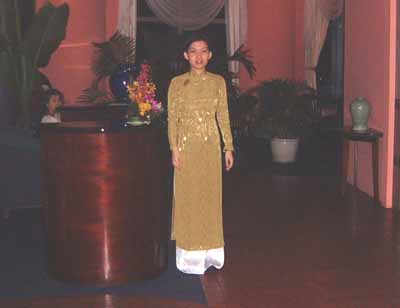
At the Saigon Trade Center.
|
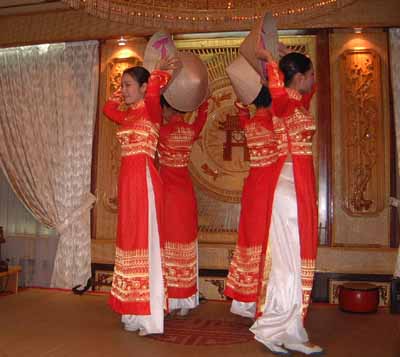
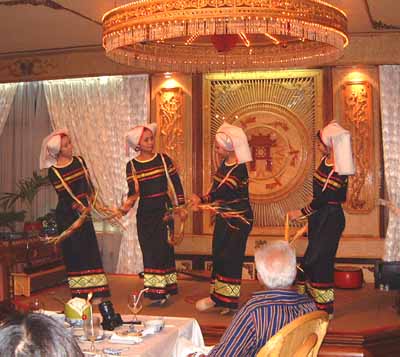
[ Traditional dance show ]
|
|
|
Traditional Vietnamese dance show at Restaurant Fleur d'abricotier
|
[ Reunification Palace ]
In 1868 a residense for the French govenor general of Cochinchina wa built on this site. The residence grdually expanded and became known as Norodom Palace. When the French departed, the palace became home for South Vienamese president.
It was towards the Presidential Palace that the first Communist tanks in Saigon rushed on the morning of 30 April 1975. After crashing through the wrough iron gates a soldier ran into the building and up the stairs to unfurl a VC flag from the 4th floor balcony.
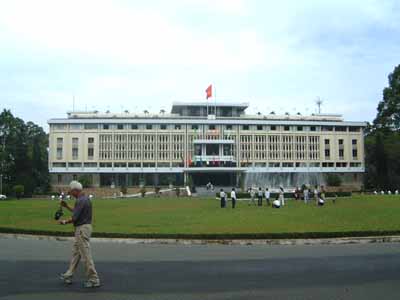
Reunification Palace (Presidential Palace)
|
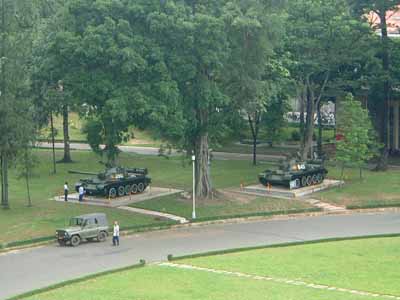
The first Communist tanks in Saigon
|
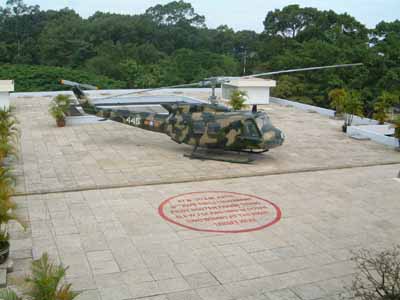
There is still a moribund helicopter parked
|
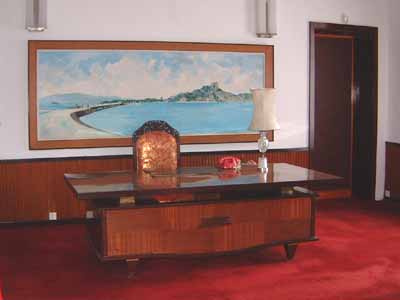
The Presidential Receiving Room
|
[ War Remnants Museum ]
Once known as the Chinese and American War Crimes, this museum's name has been changed to avoid offending the sensibilities of Chinese and American tourist. Whatever the current name, War Remnants Museum has become the most popular museum in Saigon with tourists.
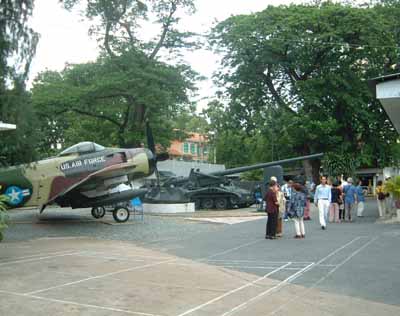
In the yard of the museum, US armoured vehicles, artillery pieces, bomb and infantry weapons are display. There is also a guillotine which the french used to deal with Viet Minh 'troublemakers'. Many of the photographs illustrating US atrocities are from US sources, including photo of the infamous My Lai Massacre. There is a model of the notorious tiger cages used by the South Vietnamese military to house Viet Cong (VC) prisoners on Con Son Island. There are also pictures of genetically deformed babies, their birth defects attributed to the widespread spraying of chemical herbicides by Americans. An adjacent room has exhibits displaying 'counter revolutionary war crimes' commited by saboteurs within Vietnam after 1975.
After the war, American Secretary of Defence Robeert S. McNamara wrote as follows in his retrospect "The Tragedy And Lessons Of Vietnam".
The following figures represent a part of those terrible wrong doings. In the Vietnam war, the US Government mobilized 6.5 million young people who took turns in fighting. The total US Force reached 543,400 men engaged, including 70% from the Army, 60% from the air Force, 60% from the Marines and 40% from the Navy.
22,000 US plants and factories supplied the war with their products. 7,850,000 tons of bombs of all kinds were dropped over Vietnam plus 75,000,000 liters of defoliants -including dioxin- were sprayed over croplands, farmlands, forestlands and villages in the southern part of this country. In World War Two, the US had dropped 2,057,244 tons of bombs over different battlefields. According to the figure made public by US government, 352 billion dollars were spend for the Vietnam war.
In North Vietnam bombs and bullets destroyed or heavyly damaged 2,923 school buildings -from primary schools to collages- 1,850 hospitals, wards, nurseries, 484 churches and 465 temples and pagodas.
Nearly 3 million Vietnamese were killed, and 4 million other injured, according to incomlete figures.
Over 58,000 American armyman died in the war. Yet long-term consequences have not been completely determined in the Vietnam war. In retrospect, it is not for inciting hatred, but just for learning lessons from histroy : human being will not tolerate such a disaster happening again, neither in Vietnam nor anywhere on our planet.
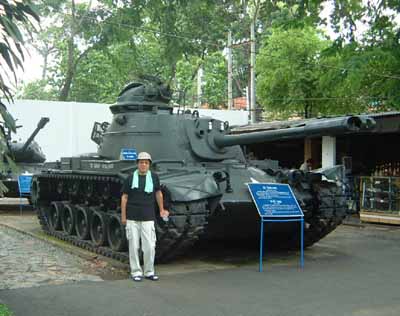
|
 |
|
Displays in the yard of the museum.
|
[ History Museum ]
The History Museum , built in 1929, was once the National Museum of the Republic of Vietnam. It's just inside the main entrance to the zoo on D Ngyuyen Binh Khieh. The museum has an excellent collection of artefacts illustrating the evolution of cultures of vietnam, from the Bronze Age dong son civilisation to the Oc Eo civilization, to the Chams, Khmers and Vietnamese. There are many valuable relics taken from Cambodia's Angkor Wat.
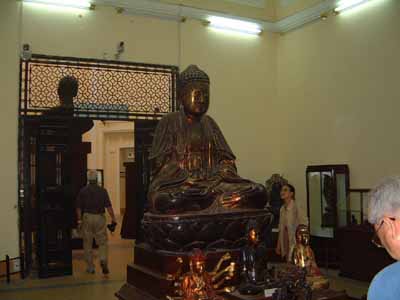
Big Buddha in the center holl
|
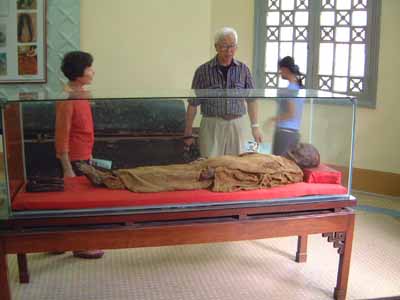
Mummy of an old woman
|
[ Cholon ]
To the west of the city center is the huge Chinese neighborhood called Cholon where they call "Chinatown". In fact, Cholon means "Big Market", and the Chinese have traditionally played a big part in Vietnam's economy.
In Cholon, we visited Thien Hau Pagoda and Ben Thanh Market.
Thien Hau Pagoda was built by the Cantonese congregation in the eary 19th century. The pagoda is dedicated to Thien Hau. It is said that Thien Hau can travel over the ocean on a mat and ride the clouds to wherever she pleased. Her mobility allows her to save people in trouble on the high seas.
Ben Thanh Market is very big indoor market. You will find everything we need in our daily life. There is the livestock market where the trade in chickens, geese and ducks, tied together in bundles, was brisk.
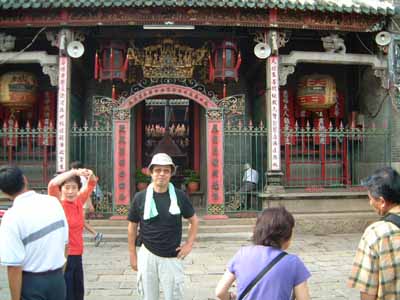
Thien Hau Pagoda
|
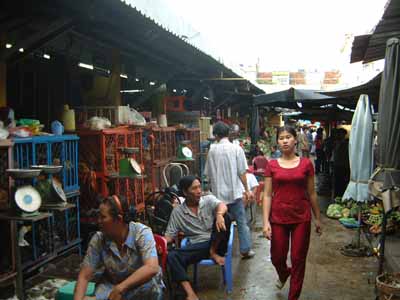
Ben Thanh Market
|
[ Mytho ]
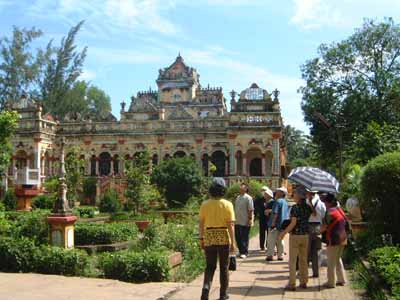
Mytho, the capital of Tien Giang Province, is a Quiet city of 100,000. It's the closest Mekong Delta city to Saigon, and for this reason package tourists come here for day trips. Having spent two hours in Mytho, they can go home and say "I've seen the Mekong River".
|
|
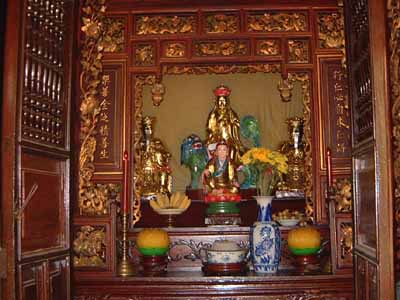
Van Thanh Mieu Temple
During the war many monks of this temple burned himself to death to protest the war.
|
[ Boat Tour of Mekong ]
Pancake flat but lusciously green and beautiful, the Mekong Delta is the southernmost region of Vietnam. It was formed by sediment deposited by the Mekong River, a process which continues today ; silt deposits extend the delta's shoreline at the month of the river by as much as 79m per year. The river is so large that it has two daily tides indeed, at low tide in the dry season, boats cannot even move through the shallow canals. The Mekong begins rise around the end of May and reaches its highest point in september.
Boat trips were the highlight of our visit to Mekong. The small wooden vessels can navigate the Mekong, cruising past pleasant rural villages through the maze of small canals.
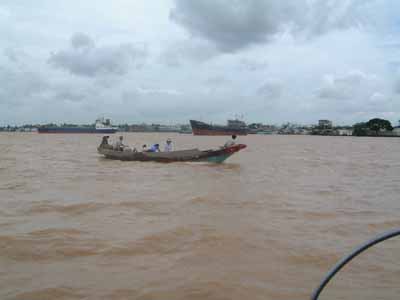
Mekong River in the rainy season.
|
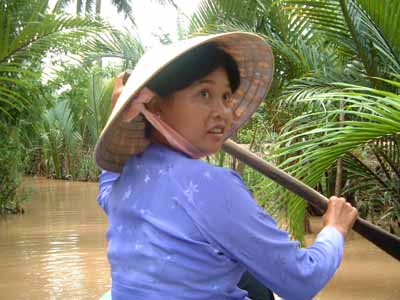
Went down the canal on the boat.
|
[ Cu Chi Tunnels ]
The town of Ch Chi had about 80,000 residents during the American War, but has now become a district of greater Ho Chi Minh City with a population of 200,000. At first glance, there is little evidence here to indicate the intense fighting, bombing and destruction that went on in Cu Chi during the war. To see what went on, we have to dig deeper underground.
The tunnel network of Cu Chi became legendary during the 1960s for its role in facilitating Viet Cong control of a large rural area only 30 to 40km from Saigon. At its height, the tunnel system stretched from the South Vietnamese capital to the Cambodian border, in the district of Cu Chi alone, there were over 250km of tunnels. The network, parts of which were several storys deep, included innumerable trapdoors, specially constructed living areas, storage facilities, weapons facilities, field hospitals, command centers and kitchens.
The tunnels made possible communication and coordination between VC controled enclaves isolated from each other by South Vietnamese and American land and air operations. They also allowed the guerrillas to mount surprise attacks wherever the tunnels went, even within the perimeters of the US military base at Dong Du, and to disappear into hidden trapdoors without a trace. After ground operations against the tunnels
claimed large numbers of US casualties and proved ineffective, the Americans resorted to massive firepower, eventually turning Cu Chi's 420 sq km into what Tom Maangold and John Penycate have called "the most bombed, shelled, gassed, defoliated and generally devastated area in the warfare.
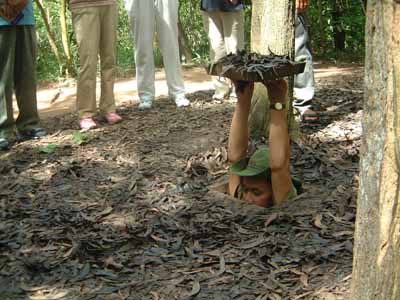
A secret entrance to the network of tunnels
|
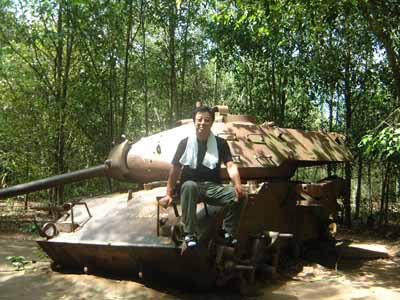
The shreds of a tank
|
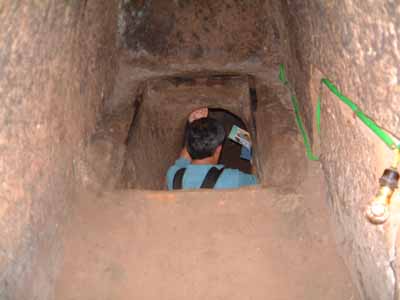
In the under earth tunnel
|
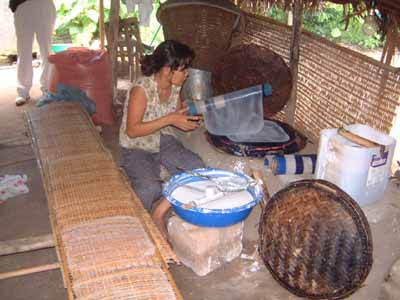
We visited a farmer's house to see how to make a rice paper.
|
Vietnam has a unique and rich civilisation, spectacular scenery and highly cultured, cordial people. While no doubt the American War continues to weigh heavily on the consciousness of all who can remember the fighting.
Well,sayonara and see you again soon.
